


AI Voice Agent Development: From Architecture to Production
Learn how to build an AI voice agent, compare voice AI architectures, address technical challenges, and integrate and deploy a production-ready solution.





Table of Contents

Whether you're building a conversational AI voice agent from scratch or integrating one into an existing product or business workflow, the technical decisions you make early on will shape how it performs in production. These include the choice of AI models, system architecture, conversation management, and integration with existing applications.
The right architecture depends on what the agent needs to accomplish. An AI voice agent conducting adaptive interviews, for example, may have different requirements for conversation management, access to data, and system integrations than one handling customer requests and executing complex business workflows.
In this article, we examine the key architectural approaches to AI voice agent development, the technical challenges of building conversational systems, and what it takes to deploy a reliable voice agent in production.
A conversational AI voice agent interacts with users through spoken language in real time. It can interpret requests, ask follow-up questions, maintain context across multiple conversational turns, and perform actions within connected applications.
These capabilities rely on several functional layers, each responsible for a different part of the interaction.
| Functional layer | Role in the system |
| Audio transport | Streams audio between the user and the voice agent through telephony, web, or mobile interfaces. |
| Speech understanding | Processes spoken input and interprets its meaning within the conversational context. |
| Dialogue management | Maintains conversation state and manages the flow of interaction. |
| Speech generation | Produces spoken responses with appropriate pronunciation, rhythm, and intonation. |
| Business logic and integrations | Connects the agent to external systems, retrieves data, and executes business operations. |
These capabilities can be distributed across multiple models and application components or, in the case of speech understanding and generation, combined within a multimodal AI model.
Consider a voice agent integrated into a customer service platform. During a conversation, the agent may need to identify the customer's request, retrieve account information, ask for additional details, and submit a service request through an API. If the customer corrects previously provided information, the agent needs to account for that change before completing the operation.
The orchestration layer coordinates model interactions, manages session state, and controls when external systems are called. It also handles situations such as API failures, incomplete information, and requests that require escalation to a human operator.
The choice of AI voice agent architecture depends on how the agent needs to process speech, manage conversational interactions, and respond to users. Three common approaches are streaming cascaded pipelines, turn-based native speech-to-speech, and full-duplex voice interaction.
A cascaded architecture connects three specialized AI components in a processing pipeline:
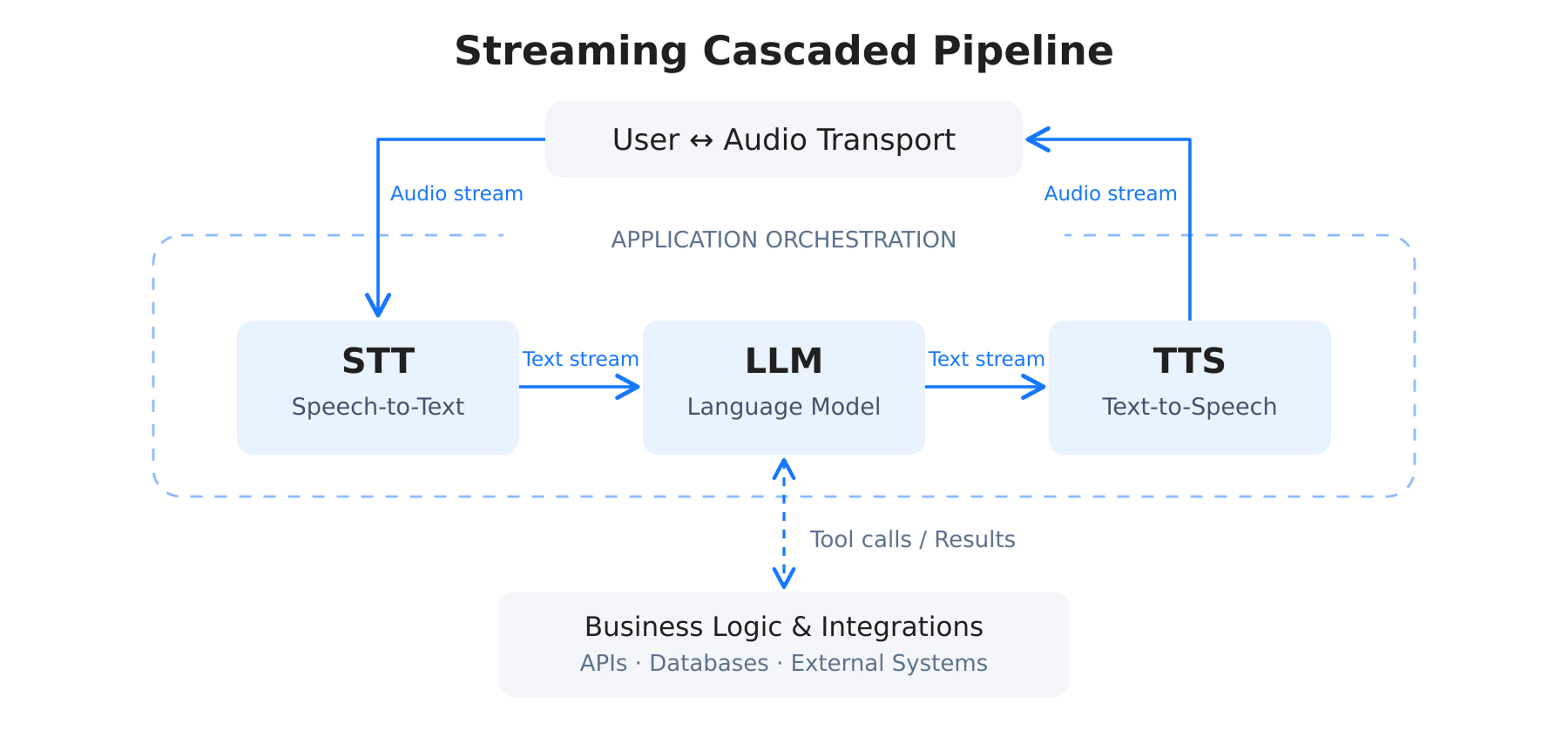
The application orchestrates data flow between these components and manages conversational turns. The modular structure allows engineering teams to select models from different providers, configure each processing stage independently, and replace individual components as product requirements evolve.
Access to intermediate text allows developers to validate data, modify responses, and apply business rules before speech synthesis. It also makes it easier to identify whether an error originated in speech recognition, language model processing, or speech generation.
Each processing stage contributes to overall conversational latency. With streaming, speech recognition can begin while the user is still speaking, and speech synthesis can start before the LLM finishes generating its response.
This approach is particularly useful when an application requires specialized speech recognition for industry-specific terminology, greater control over generated responses, or a specific voice that is available through a dedicated TTS provider.
A native speech-to-speech architecture uses a multimodal AI model that processes incoming audio directly and generates spoken responses without requiring separate STT and TTS models in the primary conversational pipeline.
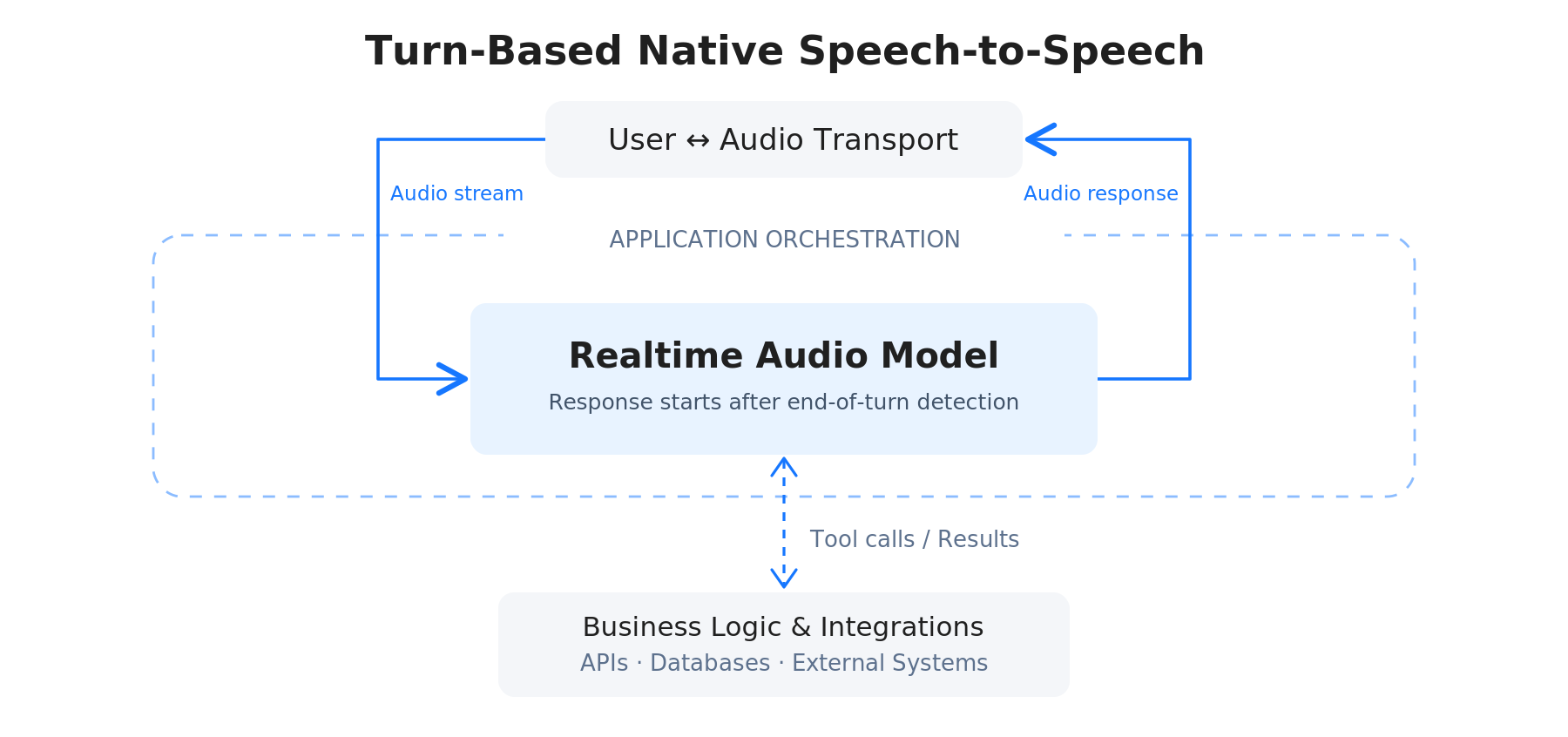
Direct audio processing allows the model to interpret acoustic information such as intonation, emphasis, and hesitation alongside the linguistic content of an utterance. By combining speech understanding and generation within a single model, this approach can also reduce intermediate processing delays.
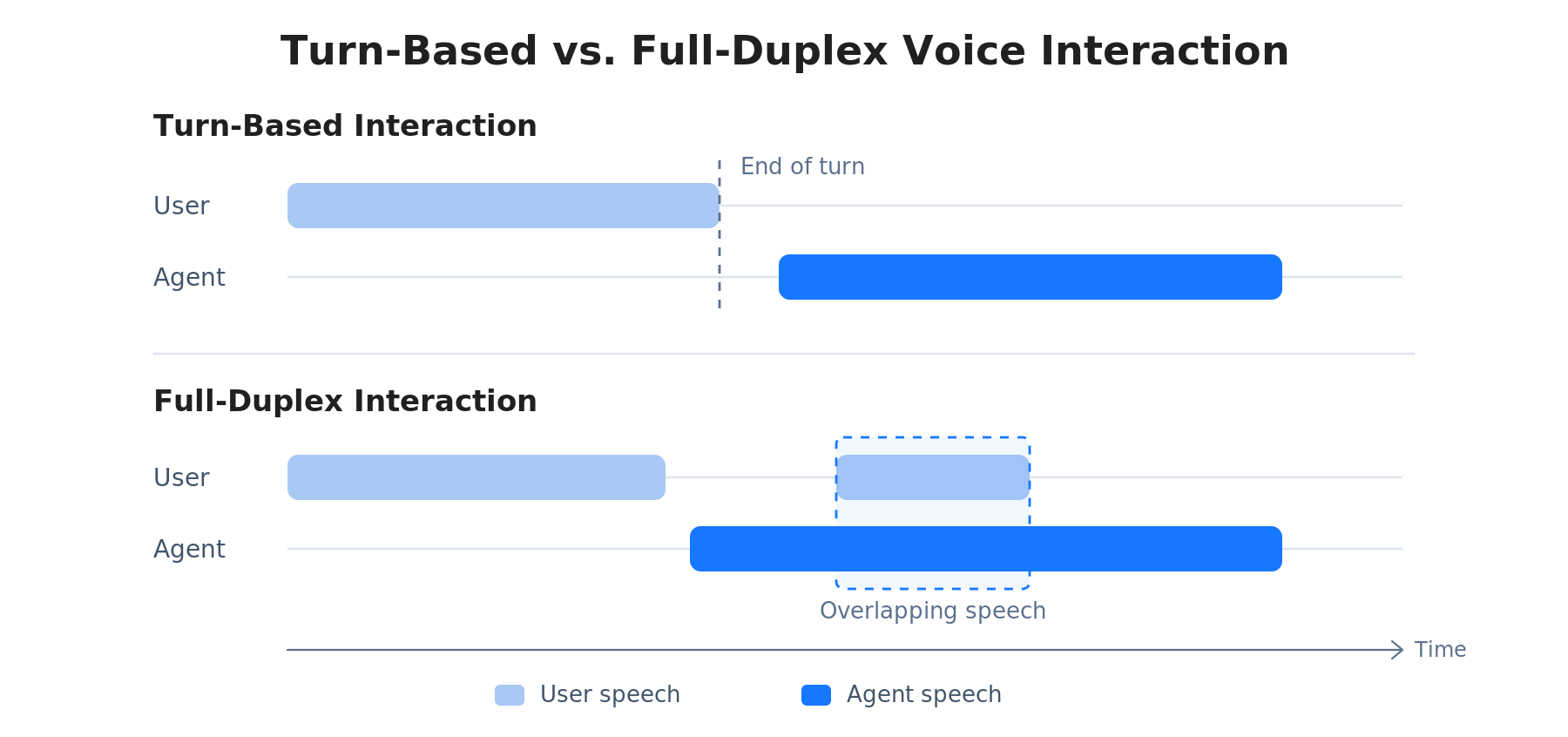
In turn-based interaction, the model begins generating a response once the user's conversational turn is considered complete. The OpenAI Realtime API, for example, supports configurable voice activity detection and semantic turn detection to determine when the user has finished speaking. It also supports interruptions, allowing the user to stop the agent's current response and take the conversational turn.
This approach is well suited to applications such as adaptive interviews, consultations, and customer service conversations, where the agent needs to understand detailed responses, maintain conversational context, and ask relevant follow-up questions.
In full-duplex interaction, the AI model continuously processes incoming audio, including while generating its own spoken response.
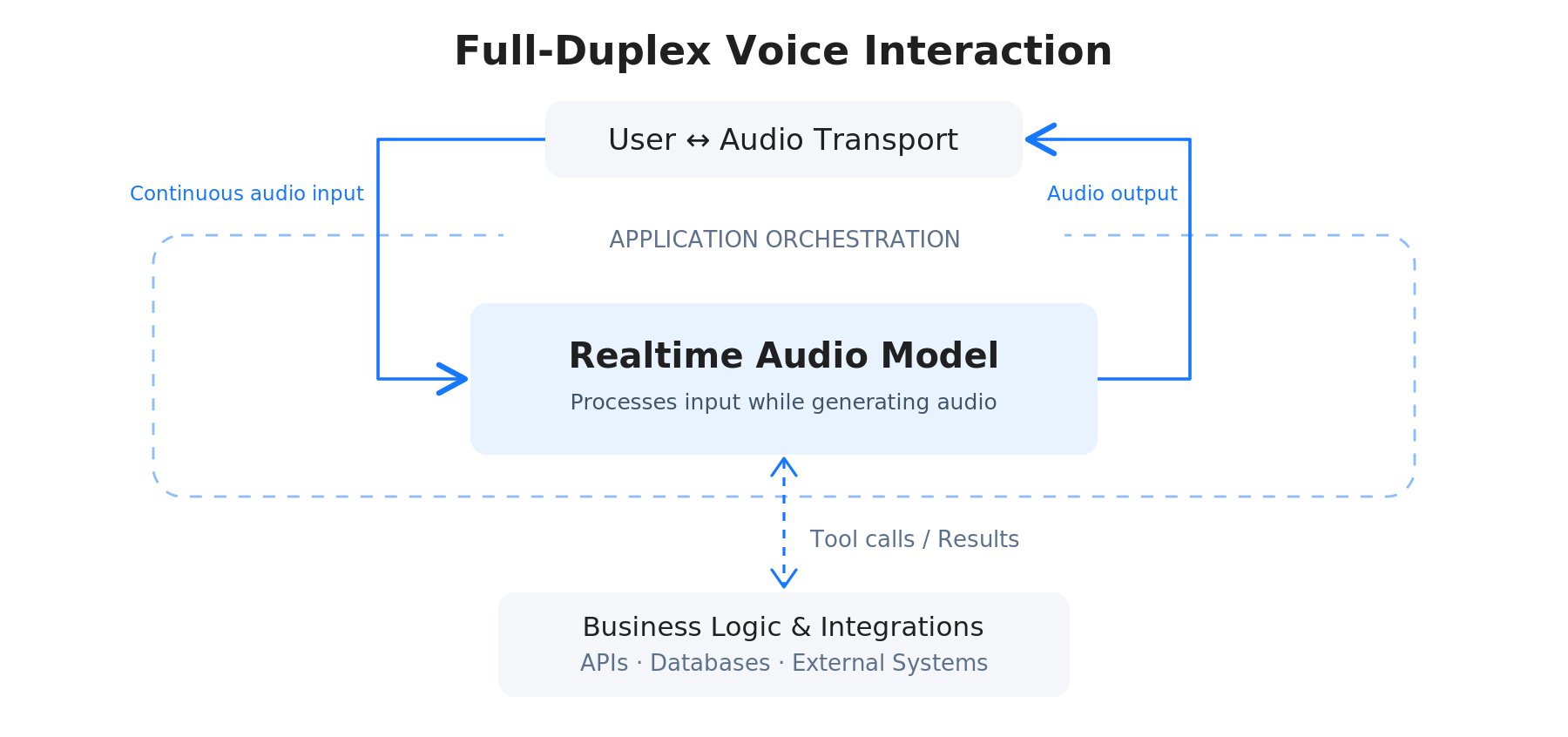
This differs from conventional barge-in handling, where the system detects that the user has started speaking, stops the agent's response, and returns the conversational turn to the user.
A full-duplex model can process overlapping speech and adjust its behavior as the conversation unfolds. It can distinguish between a brief acknowledgment and an attempt to interrupt, respond to changes in conversational context, or acknowledge what the user is saying without waiting for a complete turn.
OpenAI GPT-Live is an example of this approach. Its architecture also allows the voice model to maintain the conversation while delegating more complex reasoning and tool execution to a separate backend.
Full-duplex interaction is particularly relevant for applications where conversations involve frequent interruptions, short exchanges, overlapping speech, or continuous communication, such as interactive voice assistants, live translation, and real-time conversational support.
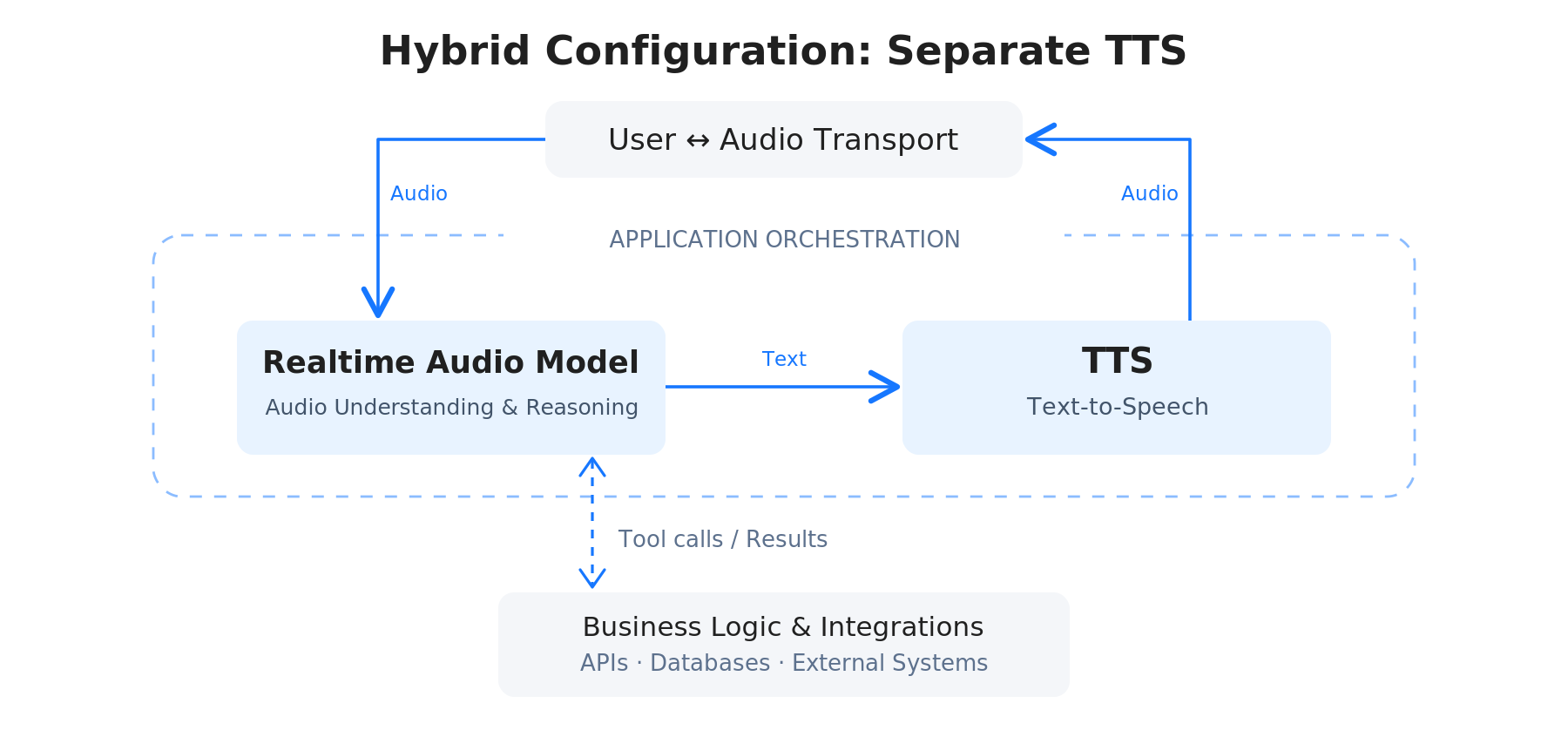
Engineering teams can also combine components from different architectural approaches to meet specific product requirements.
For example, when developing a Hebrew-speaking voice agent, a realtime audio model can process incoming speech directly and generate text responses, while a dedicated TTS model synthesizes the output using a selected native Hebrew speaker's voice. This configuration retains native audio understanding while providing greater control over pronunciation, accent, and voice identity.
Application Backend
Any of the three approaches can be combined with a separate backend to handle business logic, integrations with external systems, application state management, and additional domain-specific analysis during or after a conversation.
| Criteria | Streaming Cascaded Pipeline | Turn-Based Native Speech-to-Speech | Full-Duplex Voice Interaction |
| Processing approach | STT → LLM → TTS | Direct audio input and output | Continuous, simultaneous audio input and output |
| Conversation management | Application-managed turn-taking | Turn-based interaction with interruption handling | Continuous interaction with support for overlapping speech |
| Key strength | Independent control over speech recognition, reasoning, and speech generation | Native audio understanding and response generation | Dynamic conversational interaction |
| Conversational latency | Can be optimized through streaming | Can reduce intermediate processing delays | Can reduce delays associated with explicit turn-taking |
| Best suited for | Applications requiring independent customization of speech recognition, language models, and speech synthesis | Applications involving structured dialogue and extended conversational turns | Applications requiring continuous speech processing and simultaneous listening and speaking |
When developing our AI recruiting product, Makehire, we initially built Mia using a cascaded pipeline, then moved to OpenAI Realtime and tested GPT-Live. We chose OpenAI Realtime for our current interview workflow because its interaction model better suited the conversational requirements of adaptive interviews.
A separate backend tracks which topics the candidate has covered during the interview and initiates a detailed candidate assessment once the interview is complete.
Looking to Automate Candidate Screening and Interviews?
See how Mia conducts adaptive AI voice interviews
An AI voice agent can integrate with existing telephony infrastructure to receive inbound calls and initiate outbound calls. Integration with CRM, ERP, field service management platforms, and other business systems allows the agent to access operational data and execute business processes during a call.
Consider a service company that provides equipment maintenance and repair. An AI voice agent could manage the following workflow:
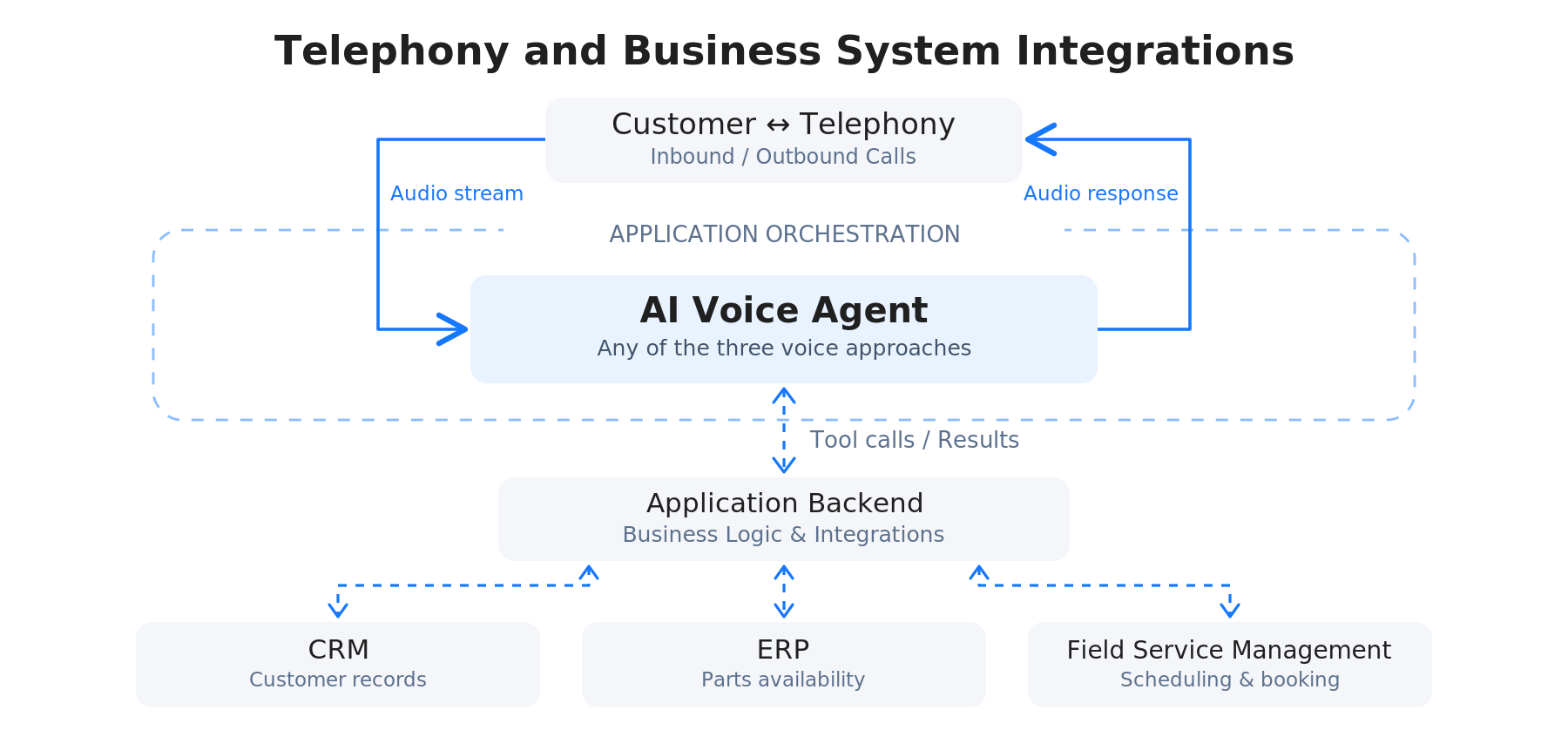
This workflow can be implemented using any of the three voice interaction approaches. The voice architecture determines how the agent handles the conversation, while the application backend coordinates data retrieval, validates information, executes business operations, and manages their dependencies across connected systems.
Planning to Develop a Conversational AI Voice Agent?
Explore Our AI Implementation Services
Understanding spoken language involves dealing with background noise, variations in speaking rate, accents, domain-specific terminology, and incomplete sentences. In applications that rely on automatic speech recognition (ASR), transcription errors can affect how the language model interprets a request and what information is passed to connected systems.
The significance of an error depends on the application. Misrecognizing a filler word may have little effect on the conversation, while misinterpreting a date, medication name, or technical qualification can change the meaning of an answer or lead to an incorrect business operation.
Speech recognition accuracy and semantic accuracy should therefore be evaluated separately where applicable. The latter measures how well the system preserves the meaning and relevant information in spoken input.
A conversational AI voice agent needs to maintain context across multiple exchanges, track the information collected during the interaction, and account for changes in user intent.
In a complex conversation, the context available to the AI model and the application state serve different purposes. The model uses conversation history to interpret requests and generate relevant responses. The application state can store validated information, completed actions, outstanding requirements, and the current status of business operations.
Consider an AI voice agent handling a service request. If the user changes the requested date after the agent has checked availability, the application needs to update the relevant information and repeat the availability check before confirming the request.
These challenges were examined in Full-Duplex-Bench-v3, a benchmark introduced in April 2026. Researchers evaluated six voice agent configurations using real human speech recordings and scenarios requiring multiple API calls. Handling user self-corrections and completing complex multi-step tasks remained common challenges across the evaluated systems.
Natural speech generation involves accurate pronunciation and appropriate prosody — the rhythm, intonation, stress, and pauses that help convey meaning in spoken language.
The appropriate speech delivery depends on the context of the conversation. A voice agent conducting an interview needs to formulate questions, acknowledge answers, and request clarification without disrupting the speaker's train of thought. An agent providing technical support may need to deliver instructions at a pace that allows the user to follow them.
In systems using streaming TTS, audio generation can begin before the language model has completed its response. However, processing text in smaller segments may reduce the linguistic context available to the speech synthesis model, affecting phrasing and intonation.
One of the more complex aspects of conversational voice AI is determining when the agent should speak, continue listening, or stop its current response.
Several mechanisms contribute to this process.
| Mechanism | Function |
| Voice Activity Detection (VAD) | Detects the presence of speech in an audio signal. |
| Endpointing | Estimates when an utterance has ended. |
| Semantic turn detection | Uses linguistic and contextual information to estimate whether the speaker has completed their thought. |
| Barge-in handling | Allows the user to interrupt the agent while it is speaking. |
| Backchannel handling | Accounts for brief acknowledgments, such as "mm-hmm" or "I see," without treating every acknowledgment as an interruption. |
These mechanisms can operate at the model, framework, or application level, depending on the architecture.
Interruption handling also requires coordination with conversation state. When a user interrupts a response, the system may need to stop audio playback, cancel ongoing generation, and adjust the conversation history to reflect what the user actually heard.
End-to-end conversational latency is influenced by several factors, including network transmission, turn detection, speech processing, model inference, audio generation, and external tool execution.
Some of these processes can run concurrently. Others depend on the completion of previous operations. An agent checking appointment availability, for example, may need to wait for a response from an external scheduling system before providing an accurate answer.
Reducing latency also involves balancing response speed with conversational behavior. Shorter endpointing delays can improve responsiveness but may increase the likelihood of interrupting users during natural pauses.
Engineering teams can assess these trade-offs using several metrics.
| Metric | What it measures |
| End-to-end response latency | Time between the end of the user's turn and the beginning of the agent's audible response. |
| Interruption latency | Time between the start of a user interruption and the agent stopping its speech. |
| Tool execution latency | Time required to execute an external operation and receive its result. |
| P95 response latency | Response latency at or below which 95% of measured interactions fall. |
Measuring latency at different stages helps identify whether delays originate in the AI models, conversation management mechanisms, infrastructure, or connected business systems.
The development process begins with understanding how the voice agent will operate within the product or business process. These requirements determine the scope of engineering work, the architecture, and the necessary integrations.
During the discovery phase, the engineering team and the business should establish:
When developing an AI voice agent for a SaaS product, this stage also involves reviewing the existing application's architecture, available APIs, and data structures.
Model selection should be based on the requirements of the application and the performance of candidate models in representative conversational scenarios.
Based on the proof of concept (PoC) results, the engineering team can refine the system architecture, finalize the technology stack, and define the scope of development.
This stage also helps determine which capabilities can be implemented using existing AI technologies and which require custom engineering. For example, a realtime audio model may already meet the application's conversational requirements, while data validation, domain-specific reasoning, or complex business workflows may require additional components.
The outcome of this phase is a proposed system architecture, technology stack, and development scope informed by the results of technical validation.
Conversation design defines how the agent conducts interactions, responds to different types of user input, and progresses toward the intended outcome.
For relatively predictable interactions, the agent may follow predefined conversational stages. More complex applications require dynamic dialogue management, allowing the agent to adapt its questions and responses based on the information collected during the conversation.
Engineering work at this stage may include:
The development team also determines which decisions can be delegated to the AI model and which require deterministic application logic. This distinction is particularly important when conversations involve sensitive information or actions with business consequences.
For many applications, the value of a conversational voice agent depends on its ability to complete tasks within existing business systems.
Voice AI integration may involve connecting the agent to CRM platforms, scheduling systems, internal databases, knowledge bases, or proprietary product APIs.
The integration layer defines what information the agent can access, which operations it can perform, and how the application validates those operations.
For example, an AI voice agent handling appointment scheduling needs to retrieve available time slots, interpret the user's preference, create a booking, and confirm that the operation was completed successfully. It also needs to account for unavailable time slots, changes in user preferences, and external system errors.
Authorization, data validation, error handling, and operation status tracking should be implemented at the application level. Operations that modify external data may also require idempotency mechanisms to prevent duplicate bookings, service requests, or other transactions when API calls are retried.
A voice agent may perform well during a controlled demonstration but encounter difficulties when exposed to real conversations, unexpected requests, and variable audio conditions.
The τ-Voice benchmark presented at ICML 2026 evaluates voice agents through business tasks under different conversational and audio conditions. Its approach reflects the importance of assessing complete interactions, including whether the agent successfully executes the intended task.
An evaluation framework for a production-ready voice agent should cover several areas.
| Evaluation area | What to assess |
| Speech understanding | Accuracy of interpreted requests and extracted information |
| Conversational quality | Naturalness, context retention, relevant responses, and clarification behavior |
| Real-time interaction | Response latency, turn-taking, and interruption handling |
| Task execution | Task completion rate and correctness of business operations |
| Operational reliability | Failed sessions, integration errors, concurrent session capacity, and cost per conversation |
Before full-scale deployment, a pilot with a limited group of users can help identify issues that were not apparent during development.
Once the agent is in production, application traces, conversation records, performance metrics, and tool execution logs can provide insight into how the system behaves under real operating conditions, subject to applicable privacy and data retention requirements.
Failed or incomplete interactions can become part of a regression testing dataset, allowing engineering teams to evaluate subsequent changes to AI models, conversation logic, and integrations before releasing them into production.
Ready-made voice AI platforms can be a practical choice for businesses looking to automate established processes, such as appointment scheduling or routine customer inquiries.
Custom development is worth considering when:
The decision also has long-term implications. For a SaaS company, for example, relying on a particular platform may influence how quickly it can introduce new features, respond to customer requirements, or manage operating costs as usage grows.
Custom AI voice agent development can incorporate existing AI models and voice infrastructure, with engineering efforts focused on the components that are specific to your product.
An experienced engineering partner can help assess these requirements, determine the appropriate level of customization, and establish a realistic development scope before significant resources are committed.
Olive Systems develops conversational AI voice agents for companies looking to introduce voice-based functionality into their products or automate business processes.
Our engineering team supports the entire development lifecycle, from technical feasibility assessment and architecture design to custom development, system integration, and production deployment.
Whether you're building a new AI-powered product, extending an existing SaaS platform, or implementing a voice agent within your business operations, we can help turn your requirements into a production-ready solution.
Build a Custom AI Voice Agent with Olive Systems
Book a call


